Some writing days feel like a battle.
The laptop is open. The calendar is blocked. The intention is real. And still, nothing happens. The cursor blinks like it’s judging you.
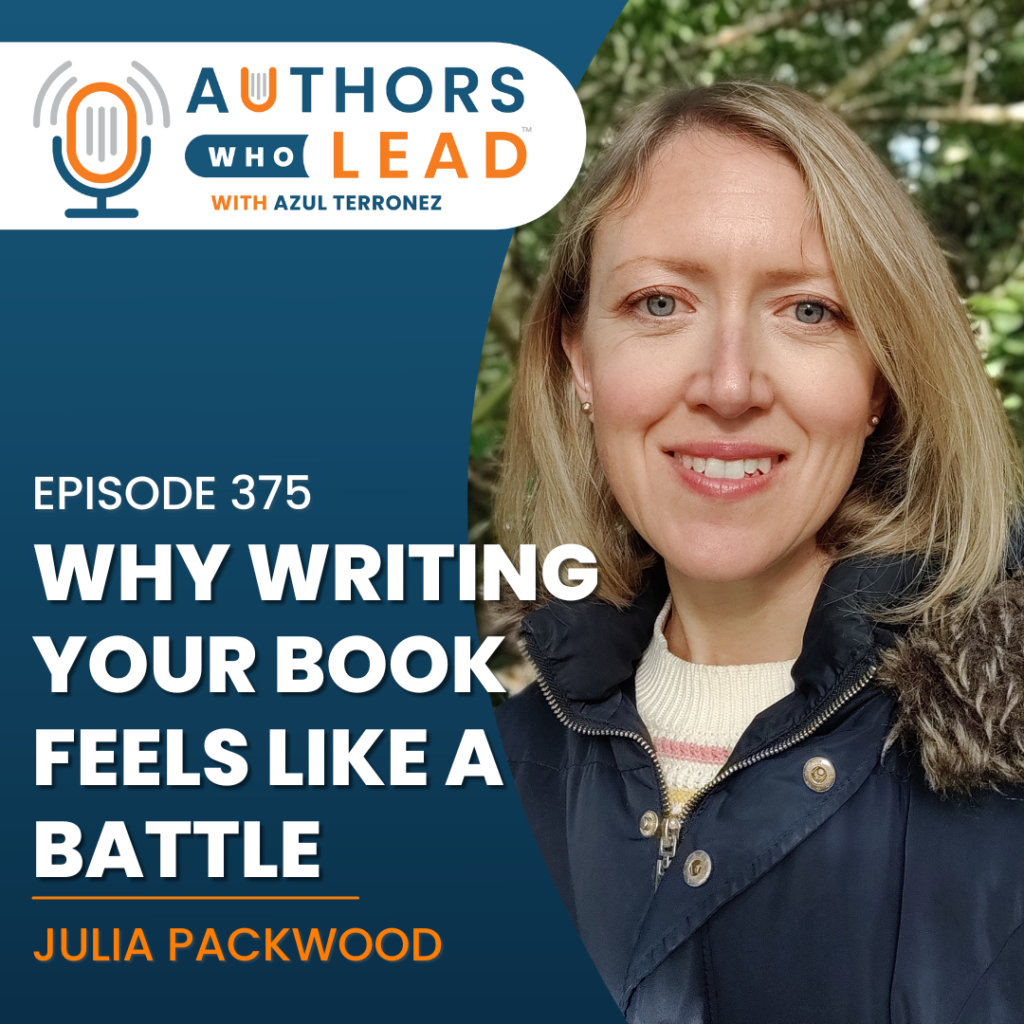
In this of Authors Who Lead, I speak with Julia Packwood, founder of Nurturing Wild Ltd—an educator and forest school leader who helps families reconnect with nature through play. Julia shares something many writers feel but rarely say out loud: writing gets done, but it can feel like a physical and mental ordeal.
That confession matters because it tells the truth.
Writing is not always smooth. It’s not always fun. It’s not always clear. And most importantly, the struggle does not mean something is wrong with you.
It may mean you’re trying to write in the wrong environment, using the wrong rules.
The First Shift: Stop Treating Writing Like School
Many of us learned to write in one setting: school.
School trained us to write for someone else—for approval, for a grade, for a deadline, for a rubric. We were conditioned to believe there is a “right” way to do it, and someone outside of us decides when it’s good enough.
So when we sit down to write a book that comes from our own calling, something in us panics.
Who decides when it’s done?
How do I know if it’s good?
What if I’m not qualified?
What if I waste time?
What if I’m wrong?
That panic isn’t proof you should stop. It’s proof you’re stepping into a different kind of writing—the kind that asks for presence, not performance.
The Hidden Problem: Your Book and Your Room Don’t Match
Julia’s work is rooted in outdoor learning, nature-based play, and helping children reconnect with wonder. Yet her writing sessions were happening in a spare room, at a desk, inside a box-like space.
That isn’t wrong. It’s just worth noticing.
If the message of your book lives somewhere—in the woods, in a garden, in a kitchen, in a studio, in a classroom—then writing in a space that feels like an obligation can quietly create resistance.
When your body is in one place, and your book is in another, the work starts to feel like pushing a boulder uphill.
So I offered Julia a simple experiment:
Take the writing practice out of the office. Bring it into the environment your book is actually about.
Write in Nature. Edit at the Desk.
Here’s the method in one sentence:
Write where the message lives. Edit where the tools live.
Writing and editing are not the same activity. They require different energy.
Writing is playful, messy, curious, alive.
Editing is structured, technical, tightening, shaping.
When you try to do both at once, the editor barges in too early and strangles the creative voice before it can speak.
Julia immediately recognized what this meant for her. She’s inspired outside. She notices water droplets on leaves. She watches children marvel at snails, sticks, and moments adults usually rush past. That’s where her book lives.
Instead of forcing chapters into existence at a desk, she can gather words outdoors—then return later to transcribe and shape them.
No pressure. No perfection. Just capture what comes.
A Writing Prompt That Works for Busy People
Julia also raised a real concern: time.
She’s parenting. She’s building a business. Life is full. There isn’t a wide-open schedule waiting for a “writing retreat.”
So we reframed the problem.
Most people don’t have a time problem.
They have a word problem.
If you stop measuring writing by hours and start measuring it by words, everything changes.
Try this:
- Set a timer for 10 minutes
- Write without stopping
- Count how many words you wrote
- Do it again tomorrow
Ten minutes a day becomes a habit. Habit becomes momentum. Momentum becomes chapters.
And the pressure to “find time” disappears, because you’re working with the time you already have.
The Real Fear Under the Block: Feeling Exposed
As the conversation deepened, Julia named another truth: sharing publicly can feel exposing.
She started a Substack and wanted it to feel personal, not polished. She wanted to write as herself—through motherhood, nature, and real life. But each time she opened up, vulnerability hung in the air.
That’s normal.
If the message matters, honesty is required. If the writing is alive, something real will feel at stake.
The answer isn’t to hide until the book is finished. It’s to share the journey in small, honest pieces.
Write about being stuck.
Write about what changed.
Write about what you noticed outside today.
Write about the moment your child didn’t want to go out—and then didn’t want to come back in.
Your readers don’t need a perfect author. They need a real one.
A Simple Way to Start Your Book Today
If you’re stuck, try this tomorrow morning.
Take a notebook outside. No laptop. No outline. No pressure.
Write it like a letter:
“Dear Jenny,”
“Today I noticed…”
“Here’s what surprised me…”
“Here’s what I want you to remember…”
Write for 10 minutes. Stop. Close the notebook. Go live your life.
Later, if you want, bring it back to the desk and type it up.
You’re not behind. You’re not broken. You’re building your book the way nature builds anything—season by season.
The Takeaway
Julia’s biggest insight at the end of our conversation is simple and powerful:
The hard feeling isn’t a sign that something is wrong.
It is the process.
It is the rite of passage.
If a book keeps tapping you on the shoulder, it’s there for a reason.
Don’t wait until you feel ready.
Don’t wait until you have more time.
Don’t wait until the inner critic shuts up.
Take the notebook outside.
Write where your book lives.
Let the rest unfold.
🎧 Listen to the full episode with Alexia Vernon and Kaia Vernon-Oliveira on the Authors Who Lead podcast.
Or through your preferred platform: