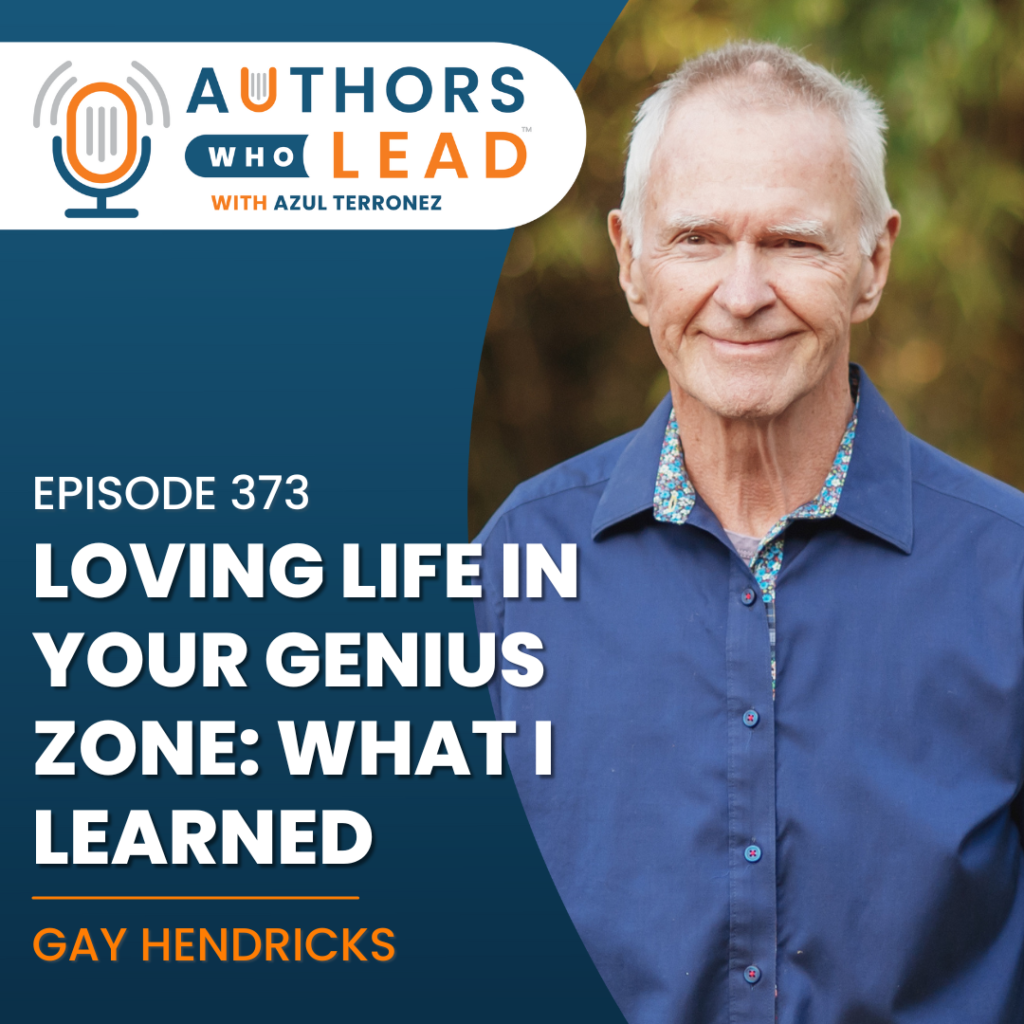
When I first started the Authors Who Lead™ podcast eight years ago, I did it with a single intention in mind: I wanted to interview Dr. Gay Hendricks. After reading The Big Leap, I sat in meditation with my husband, Steve, and set a clear, simple goal—start a podcast and, one day, bring Gay on as a guest.
When that dream came true the first time, I honestly wondered if I needed to keep podcasting. But the conversation energized me so much that I kept going. Eight years later, Gay is back, and this time we’re talking about something deeply personal: his memoir, Loving Life.
What I didn’t expect was how spiritually transformative this book—and this conversation—would be for me.
Why a Memoir After So Many Books?
If you’ve followed Gay’s work, you probably know him through The Big Leap, Conscious Loving, or Conscious Luck. He has shared countless stories about his life and his relationship with his wife and collaborator, Dr. Kathlyn (Katie) Hendricks.
So why tell his life story again?
As Gay explains, much of the inspiration came from Katie. Over the years, he’d casually share stories about odd jobs, difficult relatives, and life-changing moments. Katie would look at him and say, “You’ve got to write that down. People would love to hear that.”
After about twenty years of hearing this, Gay finally started collecting those memories and shaping them into a memoir.
But Loving Life isn’t just a collection of interesting stories. It’s a window into how a life gets built—from pain, from seeking, from missteps, and from moments of radical awakening.
The Power of the Stories We Choose
One of the things I loved most about the book was how intentional Gay was in choosing the stories he included.
When you’ve lived a rich, full life, you can’t possibly tell everything. Gay’s goal was to share stories that hadn’t appeared in his other books, stories that would illuminate the pictures on the cover: a chubby boy in fifth grade with an enigmatic smile, and a young father holding his newborn daughter.
The question behind the memoir became:
What was really happening in the life behind those images?
He also chose to highlight moments that carried both emotional and spiritual weight—experiences that shifted him not just on the level of behavior or belief, but in his core sense of who he was.
For Gay, spirituality isn’t about reaching up toward something “higher.” It’s about going inward, embracing all parts of ourselves, and discovering the presence that’s underneath everything else.
Odd Jobs, Early Suffering, and What We’re Really Seeking
As I read Loving Life, I started noticing patterns in my own story.
In the book, Gay talks about his many odd jobs—selling watermelons, working at a circus, shoveling manure. On the surface, they might look like kid jobs or entrepreneurial hacks. But beneath them, he began to see a deeper pattern of seeking: looking for something he wasn’t getting at home.
That hit me hard.
Growing up, I also had a string of strange jobs. I was a paperboy. I planted Christmas trees. I became a professional clown named Mr. Sunshine. As a five-year-old, I even went door to door selling my art.
For years, I thought that meant I was just “entrepreneurial.” But reading Gay’s stories made me realize something else: I wasn’t chasing money. I was chasing meaning, safety, and belonging. I was trying to solve problems that no one around me knew how to name.
Memoir, told with honesty, has a way of holding up a mirror like that.
The Moment on the Ice That Changed Everything
If there’s one story in the book that everything turns on, it’s the moment Gay slipped on a patch of ice.
At the time, he was over 300 pounds, smoking heavily, stuck in a toxic marriage, and carrying enormous amounts of unexpressed anger, fear, and grief. When he fell, he didn’t lose consciousness—but something else woke up.
He describes it as someone turning the lights on inside his body. For the first time, he could see how much pain he was holding—anger he’d never voiced, sorrow he’d never shared, fear he’d never admitted. But beyond all of that, he sensed a radiant field of pure consciousness, a kind of still, loving awareness that had been there all along.
That realization changed everything.
He began making choices that honored that pure consciousness. He changed his relationship with food. He released old habits that no longer fit. The changes weren’t driven by shame, but by a new sense of who he really was.
It’s one thing to read about transformation in a self-help book. It’s another to feel it unfold through the lived details of someone’s life.
Aunt Kat, Compassion, and Writing About the People We Love
One of the most moving chapters in Loving Life is about Gay’s Aunt Kat, who had Down syndrome.
She was his playmate, his teacher in Zen-like presence, and a daily invitation to compassion. Being with her meant noticing her limitations, yes—but also her joy, her spontaneity, and her refusal to hold on to negativity.
Writing about her wasn’t easy. Neither was writing about his mother, whom he affectionately calls his “piece of work” chain-smoking mayor-of-the-town mom, or his emotionally contained brother.
When you use your life as teaching material, you inevitably write about people who didn’t ask to be in your book. Gay models how to do this with honesty and respect, acknowledging their flaws without stripping them of their dignity.
As a memoir coach and author, I found this incredibly instructive. Your job isn’t to get revenge. It’s to tell the truth in a way that allows healing—for you and, hopefully, for your reader.
The Pain of Unrealized Genius
In our conversation, Gay shared something he once heard from his friend, Jean Houston: the greatest tragedy in the world isn’t just material poverty. It’s the fact that so many people never get to express their creative potential.
They get stuck behind circumstances—financial, familial, cultural—and never reach the point where they feel they are living from their true genius.
Gay defines “genius” not as talent, but as that set of activities where you feel most alive, most yourself, and most able to contribute. For him, that’s writing, teaching, and turning ideas into living, breathing experiences that help others.
For you, it might be something entirely different. The content of your genius isn’t the point. The point is whether you permit yourself to live from it.
Why This Memoir Feels Like a Spiritual Book
While Loving Life is, technically, a memoir, it reads like a spiritual guide disguised as a life story.
By the time I finished, I wasn’t just thinking, “What an interesting life.” I was asking, “What unconscious choices am I making? What pain am I still carrying? And what would it look like to fully love my life, right now?”
That’s the gift of a powerful memoir. It uses one person’s story to help you reclaim your own.
As Gay says, he doesn’t want to write any book that isn’t potentially life-changing for the person reading it. That intent is felt on every page.
Your Turn: Loving Your Own Life
If there’s one question I walked away with, it’s this:
What is my genius—and how can I live it in a way that contributes to others?
You don’t have to have your whole life figured out to ask that. You just have to be willing to tell the truth about where you are, where it hurts, and what keeps calling you forward.
That’s what Gay models in Loving Life. And that’s what I hope this conversation inspires in you.
🎧 Listen to the full episode with Dr. Gay Hendricks on the Authors Who Lead™ podcast:
Or through your preferred platform:


📚 Grab a copy of Loving Life and let it be a mirror for your own journey.